

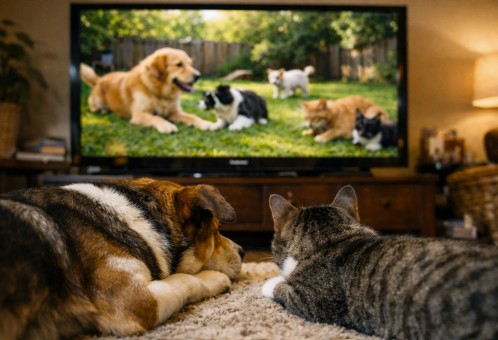
TV – It’s Not Just for Humans Anymore
Introduction by Bruce Hennes, Hennes Communications
Cat YouTube? Happy Dog TV?
Relax My Cat? DOGTV?
If you’re thinking, “What on earth does Cat YouTube have to do with crisis communications?”, that’s exactly why this
New York Times piece belongs here.
Because at its core, it’s a story about audience.
We spend our professional lives trying to influence human behavior with messages: calm people down, spur them to action, reduce uncertainty, build trust, change perceptions. And then along comes an entire mini-media industry designed to do the same thing for… dogs and cats. Not as a joke, not as novelty content, but as programming built around attention, emotion, and response. In other words: messaging with an outcome.
The article is also a crisp reminder of something executives forget at the worst possible moments: you are not the audience. Your legal team isn’t the audience. Your board isn’t the audience. The public—customers, parents, voters, patients, employees—are the audience. And like Goose the cat sprinting in at the “bloop” of the TV turning on, audiences are highly conditioned by cues, patterns, and tone. They respond to what feels familiar, safe, enraging, soothing or urgent, often faster than they can explain why.
There’s an added crisis comms lesson tucked in here, too: good intentions can backfire when you don’t understand the receiver. The piece notes that certain stimuli may stress some dogs even if they “seem” engaged. That’s a perfect metaphor for corporate and institutional communications that mistake reaction for reassurance, confusing volume, length or certainty with comfort.
So yes, this blog piece and the New York Times article below is clickbait. But it’s also a surprisingly useful lens: today’s media ecosystem is fragmented into micro-audiences with distinct triggers and preferences, and if people are building “soap operas for dogs,” imagine how narrow (and demanding) your human audiences have become.
Now, meet the world where pets are viewers, and where “string videos” rack up millions of plays. The question it quietly asks every communicator is the one we should always be asking in a crisis:
Who is actually watching—and what, exactly, are they seeing?
________________________
By Emily Anthes, writing for The New York Times
Fetching the TV Remote
Save room on the couch, because videos aimed at pets are drawing millions of views. And as with people, tastes vary.
Show me your YouTube watch history, and I will tell you who you are.
In my household, many of the videos on rotation are eye-rollingly on-the-nose for a modern Brooklyn couple in their 40s: deep dives into ancient Roman history, interviews with professional chefs, outtakes from the British comedy show “Taskmaster.”
But the most-viewed video in our apartment is a more curious artifact: footage of a strand of yarn being dragged across the screen. The video, created by the YouTube channel TV BINI, lasts over an hour and is scored with recordings of birdsong. Its devoted viewer? Our 2-year-old cat Goose.
Once upon a time, back in those young, halcyon days of the internet, cats were the stars of social media, muses for early memes and viral videos. Over the last two decades, however, we have progressed from making videos of cats (still a popular pursuit, of course) to making videos for them.
YouTube alone offers more content than my own three pets — two cats and a dog — could watch in a lifetime: videos of squeaky toys and squirrels, animated fish and feathered balls, eight hours of British birds and 21 hours of puppies playing. Roku users can download apps like “Happy Dog TV” and “Relax My Cat.” And DOGTV, a television channel and streaming service, has cinematographers who shoot original canine content in more than 20 countries, said Ron Levi, the company’s founder and chief content officer.
It’s a development that seems, somehow, both surprising and inevitable — the product of a society in which pets have become bona fide family members and fragmentation has become a defining feature of the media ecosystem. Media companies now offer niche content designed to satisfy every conceivable kind of viewer. Why not four-legged ones?
Animal Audiences
When I first heard about DOGTV, more than a decade ago, it was easy for me to dismiss it. The original idea, which came to Mr. Levi in 2006, was to create a television channel that could keep lonely dogs company while their owners were out of the house. “The idea is really to help them feel a little bit more relaxed and not anxious,” he told me. At the time, traditional TV was still king, and when DOGTV rolled out across the United States in 2013, it did so primarily as a premium cable channel, available for $4.99 a month.
I didn’t even consider subscribing. Sure, I happened to have my own Velcro dog (highly attached, determined to follow me everywhere), but I was also a freelance writer who spent most of my workdays at home and had a limited budget for cable.
For the rest, click here.